
Enhancing ship efficiency by reusing pressurized air beneath the hull
Innovating Maritime Efficiency
At Uygarlab, we develop air-lubrication systems that recycle pressurized air to cut fuel use and boost ship performance.
15
Patented Concept
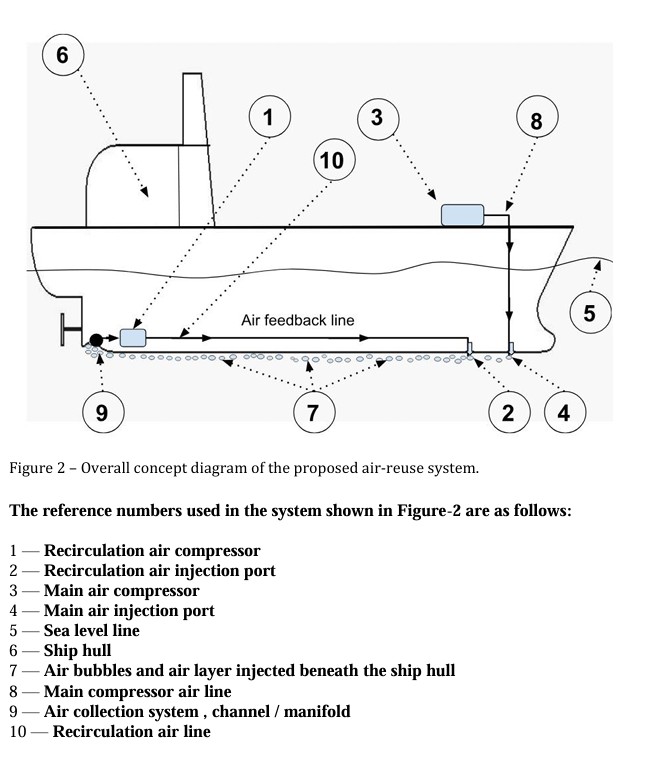
System Components of the Proposed Invention Reinjection System:
Recovered air is redistributed beneath the forward section of the ship hull through dedicated injection slots or nozzles, enabling the formation and maintenance of an air layer along the hull surface(Figure 2, reference numerals: 1, 2, 9, 10).
Air Collection System : A collection system designed according to the vessel or project requirements located near the stern region captures the air that accumulates beneath the hull during vessel operation. This air is directed into the recirculation system for reuse. (Figure 2, reference numeral: 9)
Recirculation Compressor :The recirculation compressor transfers the collected air from the collection system to the forward reinjection points. Since the air is already pressurized due to hydrostatic pressure beneath the hull, the pressure difference required for recirculation is minimal. Consequently, the energy consumption of the compressor is significantly lower compared to conventional systems that (Figure 2, reference numeral: 1)
Air Transport Ducts :Inject air directly from the atmosphere. Collected air or an air-water mixture is conveyed toward the forward reinjection locations through air transport ducts integrated within the hull structure. These ducts provide the pathway for the recirculated air between the collection region and the injection system. (Figure 2, reference numeral: 10)
Summary
Air-Lubrication System with Air Recovery for Marine Vessels
This invention relates to the field of marine engineering and concerns an air-lubrication system designed to reduce hydrodynamic friction resistance beneath the hulls of marine vessels. In conventional air-lubrication systems, the air injected under the ship’s hull generally disperses into the surrounding water and is not reused. Furthermore, because the hull operates at a certain depth below the water surface, pumping air down to this depth requires considerable energy.
In existing systems, the injected air is carried along the hull by the motion of the vessel and eventually escapes at the stern. The loss of this pressurized air represents a significant energy inefficiency. The proposed invention addresses this issue by introducing an air collection system located near the stern of the vessel, which captures the escaping lubrication air.
The collected air is then redirected through a feedback line and at least one compressor and reinjected beneath the hull for reuse. A key aspect of the invention is that the air collected beneath the hull is already at a pressure level close to the hydrostatic pressure corresponding to the operating depth of the hull. Consequently, reusing this air requires significantly less energy compared with compressing atmospheric air and pumping it down to the same depth.
As a result, the system reduces overall energy consumption while improving the efficiency of air-lubrication technology. The recovered fluid may consist of pure air or a two-phase air-water mixture. Moreover, the air-recovery principle can be applied to various air-lubrication technologies, including bubble systems, micro-bubble systems, and air-layer lubrication systems.
By maintaining a more continuous air layer beneath the hull, the invention further reduces hydrodynamic friction resistance and improves the overall energy efficiency of marine vessels.
More Information
Further technical details, analysis, and the full research document are available on Zenodo.
👉 Zenodo Research Record:
https://zenodo.org/records/19026925
This repository contains the preprint and supporting material describing the air-recovery air-lubrication system concept for marine vessels, including the engineering rationale and potential efficiency improvements.
FAQs
What is air lubrication?
It’s a method that injects air beneath a ship’s hull to reduce water friction.
How does your system work?
Our concept recovers pressurized air from under the hull to reuse it, boosting efficiency.
What benefits does it offer?
By reusing air already pressurized by water pressure, fuel consumption drops and emissions decrease.
Yes, the concept has been submitted as a patent application.
Is this technology patented?
What’s next for this project?
We’re focused on theoretical studies and exploring real-world applications.


Wasted energy
If bubbles are visible behind the ship, the compressed air energy has already been lost
In conventional air-lubrication systems, compressed air is injected beneath the ship hull to create a thin layer of bubbles that reduces friction between the hull and water. However, after travelling along the hull, most of this air escapes into the surrounding water and eventually rises to the surface.
When bubbles become visible behind the ship, it indicates that the compressed air energy used to generate them has already been lost. The compressors consumed significant power to pressurize this air, yet the air leaves the system without being reused. As a result, a portion of the energy invested in the air-lubrication process is effectively wasted.
Reducing or recovering this lost energy represents an important opportunity to improve the overall efficiency of air-lubrication systems.